Filter by

Blue Planet: Life in our Oceans and Rivers
Blue Planet: Life in Our Oceans and Rivers takes young readers on a vivid exploration of the world’s waterways — from vast oceans to meandering rivers and lakes. With bright illustrations and accessible text, the book introduces creatures of all sizes, explains the water cycle, outlines how people use and live around water, and highlights how water connects all life on Earth. It encourag…
- Edition
- -
- ISBN/ISSN
- 9781944530969
- Collation
- -
- Series Title
- -
- Call Number
- 577.54 BUT b
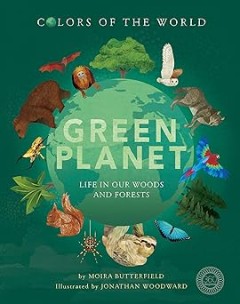
Green Planet: Life in Our Woods and Forests
Every creature in the forest—from the tiny beetle to the giant bear—depends on trees for survival. Trees give off oxygen for living things to breathe, and they provide a home for countless bugs and animals all over the planet. This engaging book introduces children to the wildlife that lives in the world’s forests.
- Edition
- -
- ISBN/ISSN
- 978-1-912756-02-5
- Collation
- 32 p. ; col. Ill. ; 29 cm.
- Series Title
- -
- Call Number
- 577 BUT g c.1

Red Planet: Life in Our Deserts and Hot Spots
Red Planet: Life in Our Deserts and Hot Spots explores the world’s most extreme heat-environments — deserts, volcanoes, geysers, hot springs, and underwater vents. The book introduces the remarkable animals and plants that manage to survive and thrive in these harsh conditions, and explains how people adapt to life in such “hot spots”. It also touches on climate change, human impact, an…
- Edition
- -
- ISBN/ISSN
- 9781944530952
- Collation
- -
- Series Title
- -
- Call Number
- 577.54 BUT r

21ST CENTURY SCIENCE: GENETICS
"21st-century science" is a buzz phrase in curriculum development, particularly at KS4/GCSE level. This series, which is also appropriate for KS3, looks at some of the new directions science is taking, at the interface between science and technology, and also discusses the social repercussions involved. GENETICS covers the science of genetics - what it is and how it will impact on our lives in …
- Edition
- -
- ISBN/ISSN
- 1-58340-350-7
- Collation
- 44 p ; 27 cm
- Series Title
- -
- Call Number
- 576.5 BUT 2 c.1 2024110249
 Computer Science, Information & General Works
  Philosophy & Psychology
  Religion
  Social Sciences
  Language
  Pure Science
  Applied Sciences
  Art & Recreation
  Literature
  History & Geography